


Participation of the United Nations Alliance of Civilizations Chair in the "Saudi Media Forum 2026"
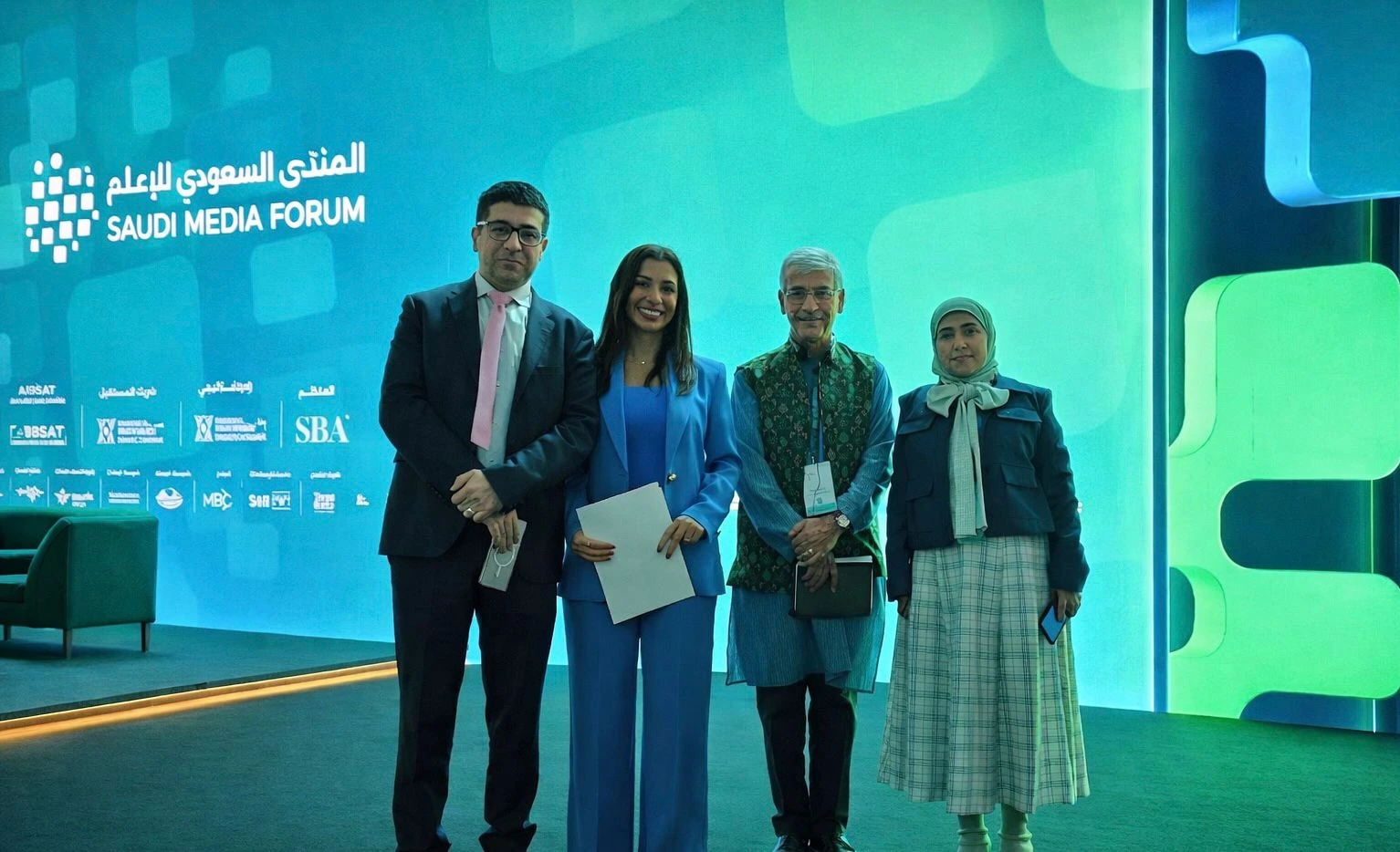

Professor Abdelhak Azzouzi, President of The United Nations Chair for the Alliance of Civilizations, participated in the fifth edition of the SAUDI MEDIA FORUM, organized this year around the theme: “Media in a Shaping World.”
On this occasion, the Forum was awarded a Guinness World Records certification as the largest media event in the world by number of participants, with 65,603 visitors, thus confirming its growing position as an international reference platform in the media sector.
As part of his participation in the session entitled “Self-Regulation: Between Freedom and Media Responsibility,” moderated by journalist Ms. Rana Abtar, Professor Azzouzi reflected on the foundations of the digital world, which has profoundly transformed modes of social communication at both local and international levels, contributing to the reduction of limits imposed by traditional geography.
This new environment offers all components of society the possibility to interact instantly and continuously with broadcast, written, or audiovisual content, allowing everyone to respond to information at any time, without constraint.
He emphasized that mastery of these digital tools confers considerable influence, capable of shaping individual and collective choices, including electoral behavior, and impacting the social stability of states. He also drew attention to the potential negative effects of these dynamics, particularly when the emotions of children and adolescents become objects of manipulation or commercialization, whether through digital platforms or algorithms, in a virtual universe now omnipresent in their daily lives, as previously analyzed in an earlier contribution.
New media and social networks have thus established an almost structural rupture with traditional audiovisual media. Indeed, elites are no longer the sole content producers, analysts, and influencers, while social networks have become open spaces, occupied by millions of users across all generations.
What does this profound transformation reveal?
The digital world now resembles a vast and difficult-to-control space, in which social networks largely escape traditional mechanisms of control and regulation. States do not always have the technical and institutional infrastructures necessary to ensure effective supervision of digital content or to interrupt its dissemination. Moreover, these platforms exert growing influence both on the internal dynamics of societies and on the international strategic environment.
It is in this context that the question of responsibility arises, which has a dual, inseparable dimension: individual responsibility and collective responsibility.
Both dimensions are intrinsically linked to the issue of values, understood as the set of universal principles, norms, and ideals that underpin the coexistence of individuals and societies. Values constitute a positive reference framework regulating behaviors, both moral and material, and encompass ethical and social virtues guiding individual conduct, ensuring coherence, balance, and stability in social interactions.
Collective responsibility, for its part, translates into the need to develop legal frameworks and international legislation capable of combating digital abuses, disinformation, and forms of content manipulation. Such an approach appears indispensable in a world in transformation, although it remains complex to implement. The central issue remains the balance to be struck between freedom of expression and the institutionalization of universally recognized values.
In other words, it is a matter of reflecting on the modalities for regulating and framing content disseminated on social networks, in order to align them with the common principles that unite humanity. Such an objective cannot fall within the competence of a single state or isolated organization; it requires collective awareness, as well as the strengthening of partnerships and coalitions at all levels, in order to create an advocacy force capable of influencing major global digital companies and algorithm designers. They are called upon to base their choices on universal human values rather than purely profit- or interest-driven logic.